Ethereum co-founder Vitalik Buterin has expressed his support for leanPCS, a cryptographic technique aimed at enhancing the blockchain’s defenses against potential threats posed by quantum computing, while keeping transaction costs and on-chain data requirements manageable.
Buterin’s shift in perspective heavily revolves around EIP-8288, a draft proposal that seeks to integrate large digital signatures and cryptographic proofs into a unified mathematical framework. This method allows Ethereum to aggregate verification data, rather than requiring separate storage for each signature that is quantum-resistant.
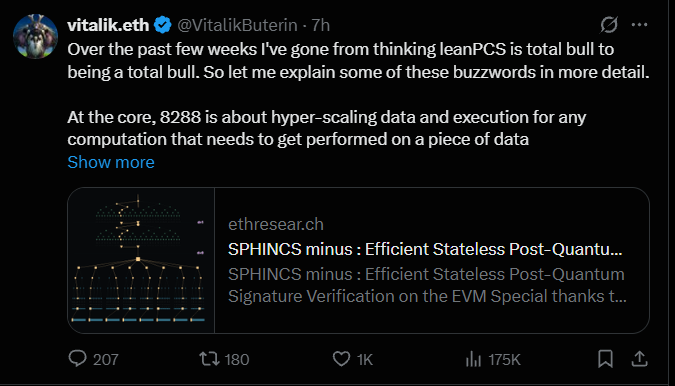
In a recent post on X, Buterin indicated a significant change in his view, stating he moved from being highly skeptical of leanPCS to fully supporting the technique.
The proposal directly addresses one of the major challenges Ethereum faces in transitioning to quantum-resistant cryptography: the potential increase in size for signatures and proofs, which could balloon from their current average of 65 bytes to anywhere between 1,000 and 6,000 bytes for some alternatives, according to Buterin. This expansion poses risks of increased transaction costs and storage inefficiencies on the blockchain, impacting user interactions with decentralized applications.
Buterin’s Endorsement and Its Implications for Ethereum’s Future
Buterin’s support signals a growing confidence in a strategy that could render Ethereum’s adoption of quantum resistance more viable. The technique employs polynomial commitment schemes, which are mathematical tools essential for cryptographic proof systems. By standardizing a shared verification component, it allows various proof systems to leverage the same foundational mechanism without necessitating uniformity in development.
Buterin argues that this could expedite Ethereum’s path toward facilitating quantum-resistant accounts and more sophisticated cryptographic applications.
EIP-8288 Promises Efficient Signature Handling
This innovative approach involves users continuing to submit their signatures or proofs to confirm the validity of transactions. However, instead of storing each large signature separately, participants can aggregate multiple verification results into consolidated proofs. Therefore, what needs to be stored on the blockchain would be limited to transaction instructions and necessary data for verifying these aggregated results, alleviating burdens on blockchain storage.
This aggregated proof technique may also benefit privacy applications that utilize zero-knowledge proofs, enabling them to adhere to required rules without disclosing sensitive information. By minimizing the data that needs individual recording, this method paves the way for advanced cryptographic features without overwhelming Ethereum’s storage resources.
Exploring Different Methods for Quantum-Safe Transition
EIP-8288 outlines three distinct strategies for managing the increased signatures and proofs necessitated by quantum-resistant systems. The first option, leanSPHINCS, focuses on a specific family of hash-based, quantum-resistant signatures. While it provides a clear pathway for protecting Ethereum accounts, its applicability is limited to that particular signature system.
Alternatively, leanSTARK offers a broader and more flexible approach, capable of supporting various signature schemes and privacy applications. However, implementing this method would depend on the Ethereum community’s consensus on a new programming language for verification processes, which could represent a substantial shift from the existing Ethereum Virtual Machine (EVM) framework.
Buterin favors leanSTARK for its potential to be rolled out significantly sooner, allowing Ethereum to enhance its cryptographic capabilities over time. He envisions a promising opportunity for entering what he terms a “cryptographic proof singularity” ahead of original timelines.
Progress in Ethereum’s Quantum-Security Roadmap
Buterin’s latest endorsement aligns with Ethereum developers’ ongoing efforts to prioritize defense against possible quantum computing threats. Earlier this year, the Ethereum Foundation established a dedicated post-quantum research team while exploring modifications to account authentication, validator keys, and privacy-focused cryptography.
If successful, EIP-8288 could bolster this broader initiative by mitigating the data and verification costs associated with quantum-resistant systems. However, as the proposal remains in draft form and its reference implementation is incomplete, Buterin’s support does not confirm its approval for deployment or a specific activation date on the mainnet.
Ultimately, if leanPCS proves practical, it could facilitate Ethereum’s incorporation of stronger cryptographic measures while minimizing impacts on transaction fees and blockchain storage demands.