The digital landscape is evolving rapidly, with centralized banks taking significant steps towards adopting decentralized technologies. Recently, the European Union announced an acceleration in its digital euro initiative, contemplating a shift towards issuing the euro on a public blockchain such as Ethereum or Solana. This strategic move emerges amidst growing concerns about the euro’s ability to compete with emerging dollar-denominated tokens in a globalized market.
As reported by the Financial Times, decision-makers within the EU are reevaluating traditional methods and are now considering leveraging established public blockchain technologies for its forthcoming digital currency.
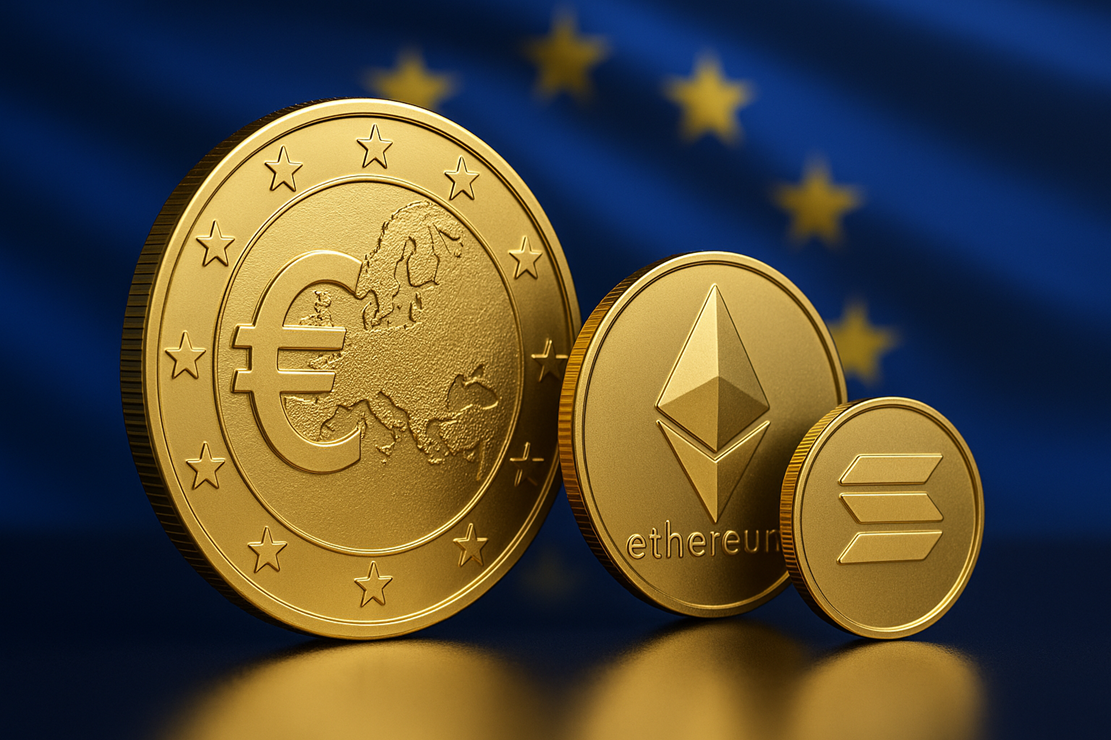
Shifting Perspectives: Why Ethereum and Solana?
This new approach marks a crucial pivot from the European Central Bank’s (ECB) previous stance, which prioritized a more controlled and privacy-centric system primarily run by the Eurosystem. The recent trends in global finance have undoubtedly influenced this change.
European officials acknowledge that the primary driving force is the increasing competition posed by the US stablecoin economy. By evaluating public blockchain options, they aim to tap into the expansive potential of the existing crypto ecosystem, although this openness also presents its own set of challenges concerning transparency and regulation.
Piero Cipollone, an executive at the ECB, has publicly articulated the importance of the digital euro as a strategy to diminish European reliance on external payment systems. In a recent address, he emphasized the need for a digital currency that mitigates the risks posed by widespread dollar stablecoin usage, which threatens the revenue streams and data security of European banks.
The ECB envisions the digital euro as a “digital equivalent of cash,” with emphasis on accessibility, privacy, and universal acceptance. However, achieving these goals within a public blockchain framework presents significant design challenges. Important considerations include wallet management, identity verification, privacy protections, and maintaining the relationship between the central bank and its intermediaries.
Public blockchains such as Ethereum and Solana offer immediate integration with various financial technologies, including tokenized assets and decentralized finance (DeFi). However, they also introduce potential policy complications that centralized systems might avoid, such as maintaining user privacy against transaction traceability and mitigating risks like network congestion.
The European officials, as per reports, are diligently navigating these complex trade-offs to ensure the euro does not lose competitive ground to dollar tokens while upholding stringent data protection and financial stability standards. A definitive decision remains pending as discussions continue.
It is crucial to understand that the deliberations are focused more on the infrastructure for implementing the digital euro rather than altering the fundamental nature of the currency itself, which will still be anchored in EU legal statutes.
Ultimately, the choice of a public blockchain like Ethereum or Solana could embed the euro CBDC within the larger framework of global token economies, leading to significant advantages in distribution alongside regulatory challenges. This could strongly signal the maturation of public blockchain technology to meet institutional demands.
If the EU officially adopts such a platform, it would serve not only as a validation for public blockchains but also as a transformative opportunity for the financial landscape in Europe and beyond.
As of recent updates, Ethereum was priced at $4,316, reflecting its ongoing significance in the crypto market.