In light of advancing technology, a new proposal has emerged regarding the future of Bitcoin ownership, especially for long-dormant holders. This initiative, introduced by researcher Dan Robinson, outlines a mechanism called Provable Address-Control Timestamps (PACTs). It aims to empower holders, including the enigmatic Satoshi Nakamoto, to preserve ownership claims for their coins in case Bitcoin implements restrictions on spending from addresses vulnerable to quantum computing threats.
The crux of Robinson’s proposal tackles a pressing concern within the Bitcoin community regarding what may happen to early Bitcoin holdings situated in addresses with public keys that are now exposed. In a recent publication titled “PACTs: Protecting Your Bitcoin From a Quantum Sunset,” Robinson warned of the potential risk posed by quantum computers, stating that “a sufficiently advanced quantum computer could compromise significant amounts of Bitcoin, leading to financial losses in the hundreds of billions.” He suggests that the community might one day opt to limit spending from addresses with exposed public keys as a protective measure.
Understanding the Implications of PACTs
This strategy could spark intense debate. The Bitcoin ecosystem values the right of holders to maintain inactivity, sometimes for long periods. Robinson positions the challenge as one without a clear solution, should the threat of cryptographically relevant quantum computers (CRQCs) become a reality.
“If a system update eliminates support for these addresses, dormant holders face a dire choice: either they must move their coins publicly or risk their complete loss. Conversely, if we disregard such an update while quantum threats loom, holders either have to act or potentially face theft. Both scenarios may compel long-term holders to sacrifice a degree of their privacy,” he explained.
This situation is particularly pressing for the Bitcoin associated with Satoshi Nakamoto, which comprises around 1.1 million BTC valued at over $75 billion as per recent estimates. Many of these early coins are held in wallets that predate contemporary wallet standards like BIP-32, creating a challenge in recovery efforts discussed in relation to BIP-361.
BIP-361 proposes a potential soft fork aimed at eventually curbing access from addresses with known public keys. Other rescue possibilities have surfaced for specific wallet categories, particularly where a holder can substantiate knowledge of a parent key that a quantum adversary wouldn’t possess. Despite these discussions, Robinson emphasizes that they do not adequately address the unique issues related to the earliest Bitcoin addresses.
pacts strive to fill this gap. This innovative proposal allows holders to create a covert, off-chain record affirming their control of a vulnerable unspent transaction output (UTXO) before a quantum attacker could potentially uncover the corresponding private key. By generating a secret salt, producing a BIP-322 full message signing proof tied to the vulnerable scriptPubKey, hashing this proof into a commitment, and timestamping it through OpenTimestamps, holders can establish this record.
Critically, this procedure does not necessitate broadcasting a Bitcoin transaction. Instead, the holder would retain the salt, the BIP-322 proof, and the OpenTimestamps proof file as a safeguard. The timestamp itself remains secure, not unveiling details about the address, public key, control proof, salt, or the coins involved.
“This framework does not compel Bitcoin to decide immediately about imposing a sunset,” Robinson remarked. “It merely provides holders a discreet way to maintain evidence that might be crucial if such a sunset is ever ratified.”
Should a future Bitcoin update freeze or sunset ECDSA spending from exposed public keys, a holder could subsequently present a post-quantum-secure proof, such as a STARK, demonstrating that the timestamped commitment predates a designated cutoff and correlates with a valid control proof for the affected UTXO. Importantly, both the salt and control proof would be kept confidential, and the rescue proof would be linked to a specific transaction, preventing any misuse.
Robinson explicitly positions PACTs as an illustrative design rather than a formal Bitcoin proposal. While the commitment phase utilizes existing tools, the rescue phase would necessitate “significant new infrastructure” within the Bitcoin framework. Furthermore, there is no certainty that Bitcoin would embrace such a rescue mechanism or even choose to restrict quantum-unsafe keys altogether.
However, this proposal is significant as it separates the discussions surrounding the need for a quantum sunset from actions that holders can take today to preserve ownership claims. This distinction is vital for early holders. Although PACTs do not resolve the overarching quantum issue, they present a means for inactive wallets to prepare discreetly for a future where their ownership might be jeopardized.
“Bitcoin emphasizes long-term readiness, risk management, and individual responsibility,” Robinson concluded. “If there is a way to lay the groundwork now to fortify against potential cryptographic threats later, it is in the best interest of long-term holders to pursue it.”
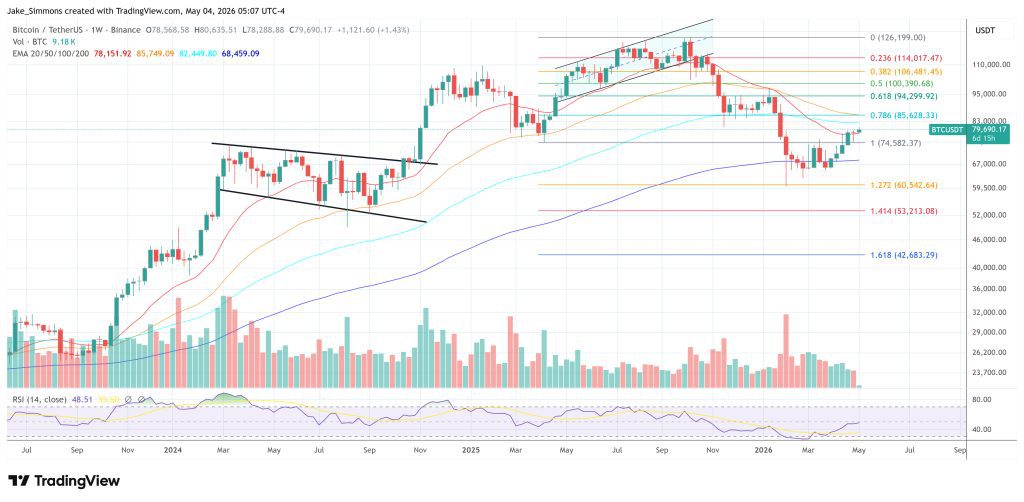
As of the latest updates, the price of Bitcoin (BTC) stands at approximately $79,690.