In recent discussions about the future of Cardano, Charles Hoskinson, its founder, has responded to assertions that the platform has favored governance initiatives over scaling solutions. He emphasized that the current development roadmap for Cardano reflects extensive research and strategic planning rather than an abrupt shift in focus.
In a recent post on X, Hoskinson expressed his frustration with what he termed a “misunderstanding” about Cardano’s commitment to scaling. He contended that progress has been ongoing, dating back to the implementation of the Shelley protocol, which includes advancements in layer-2 mechanisms, the extended Unspent Transaction Output (eUTXO) model, and ongoing research into zero-knowledge proofs and partnerchains.
“Addressing scalability is a multifaceted issue, and we have approached it through various innovative avenues, including L2 solutions, the eUOTXO accounting model, and significant research into emerging technologies,” Hoskinson explained. “These concepts demand rigorous research and original findings, which cannot be expedited merely by increasing manpower.”
Current Focus on Cardano’s Scaling Initiatives
Hoskinson’s remarks come at a crucial time for Cardano’s governance structure. Input Output, the company behind Cardano, has proposed nine funding requests for community evaluation. These proposals are integral to the long-term vision for Cardano and aim to enhance various aspects of scalability and decentralization. The request for funding in 2026 totals approximately $46.8 million, which represents a significant reduction from the $97.5 million submitted the previous year. This funding is meant to fortify the development of essential components in the roadmap while expanding the contributor ecosystem.
This proposal structure has led to some debate among community members. Hoskinson cautioned against the potential for fragmented approval of these proposals, stressing the importance of treating them as a unified package rather than isolated items. He stated, “We risk creating a disjointed outcome similar to designing a product by committee, leading to a final product that is ineffective.”
Central to Hoskinson’s argument is the idea that Cardano’s scaling initiatives are intrinsically linked to its governance framework. He believes that the Voltaire project is not an obstacle to scaling efforts but rather a necessary prerequisite for implementing significant upgrades in a decentralized system that necessitates community consensus for various decisions.
“Our scaling research has not been compromised,” he stated. “A fervent group of scientists and engineers has dedicated years to brainstorming and prototyping this architecture. We could have taken shortcuts, leading to less secure solutions, but we chose to focus on creating a robust ecosystem that stands the test of time.”
The proposed Leios initiative is at the forefront of this scaling strategy. According to Input Output’s treasury overview, Leios is characterized as the most ambitious technical project currently being developed, aimed at achieving sustainable throughput at the protocol level. A testnet for Leios is expected to launch soon, with the mainnet projected by the end of 2026, in conjunction with a wider delivery model including Intersect, Tweag, and TxPipe.
Hoskinson argues that this slower, research-intensive methodology has yielded a comprehensive design strategy for Leios and other initiatives, positioning Cardano as a leader in scalability within the cryptocurrency sector. “We have crafted solutions that are well-designed and resilient to future challenges. The time dedicated to this research has given us the best scaling strategies available,” he explained.
In addition to Leios, the proposal package incorporates enhancements for Hydra, with a planned launch of its Midgard protocol and other layer-2 agnostic tools that will facilitate scalable solutions for Cardano. The strategies surrounding Hydra and Midgard are designed to complement one another; Hydra specifically focuses on high-frequency transactions between known parties, while Midgard is set to cater to open and permissionless applications.
Hoskinson also drew comparisons to ongoing debates within Bitcoin regarding vulnerabilities, arguing that Cardano’s governance framework allows for the resolution of such debates collaboratively rather than through fractured authority structures. He mentioned that this approach could prevent the issues currently faced by Bitcoin regarding the exposure of vulnerable assets.
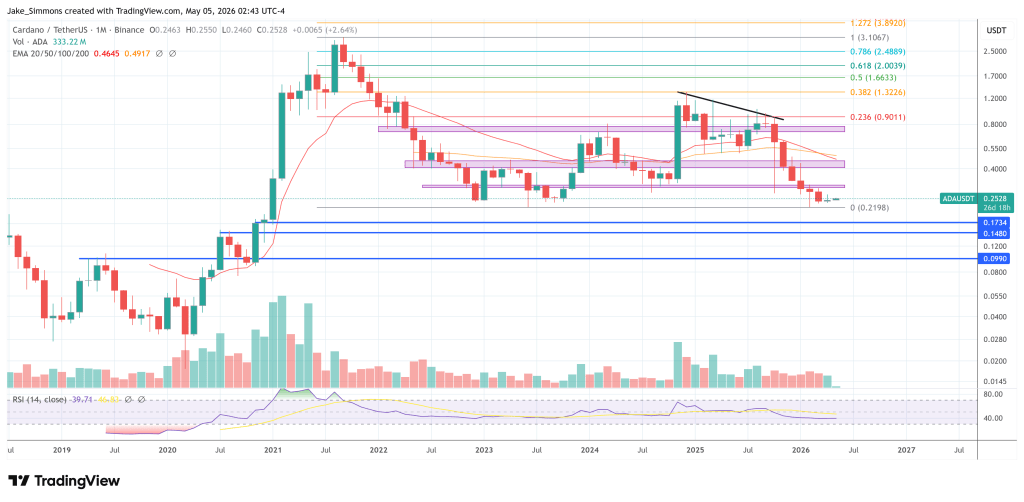
At the current time, ADA is trading at $0.2528.