Bitcoin’s Fluctuating Market Dynamics Amid $1 Billion in Liquidations
As Bitcoin faces volatility, it has struggled to maintain momentum following significant selling activity that led to over $1 billion in liquidations of bullish positions within a single day. This turmoil has raised questions about the cryptocurrency’s ability to sustain its support levels, particularly as institutional investors pull back from spot Bitcoin ETFs.
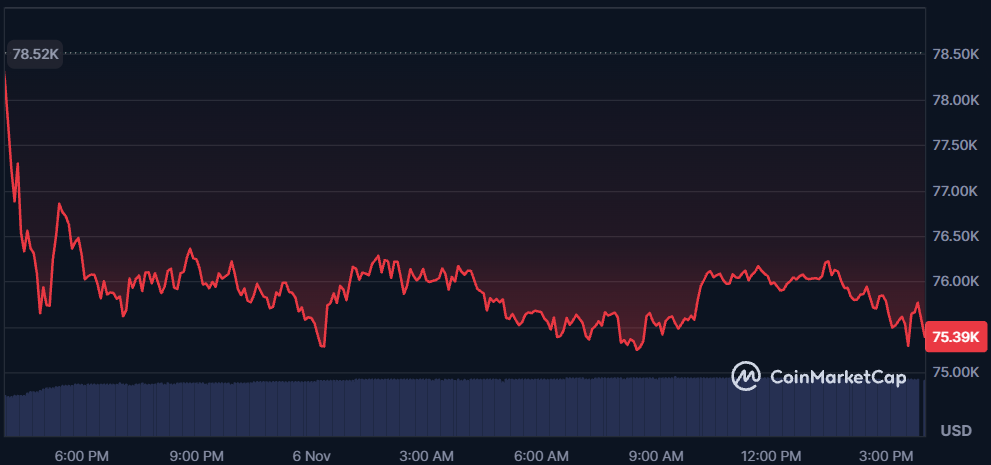
On Friday, November 6, Bitcoin’s value hovered around $76,100, marking a decline of approximately 5.2% in the preceding 24 hours. This drop followed a tumultuous period in traditional financial markets, particularly affecting technology stocks amid rising uncertainties related to investments in artificial intelligence.
Thursday’s market upheaval notably impacted leveraged traders. Data from CoinGlass revealed that about $1.27 billion in cryptocurrency derivatives were liquidated in just 24 hours, with over $1.1 billion resulting from bullish bets. This suggests that many traders expecting price hikes were forced out of their positions, exacerbating the downward pressure on Bitcoin’s price.
Market Sentiment Shifts as Liquidations Surge
The scale of the liquidations indicates a swift shift in market sentiment, particularly after Bitcoin briefly surged above $80,000 earlier in the week. This reversal coincided with a general reassessment among investors regarding their exposure to risk assets, alongside a significant sell-off in technology stocks. Concerns regarding political opposition to AI data-center construction have further complicated the current landscape.
South Korea’s Kospi index also faced substantial pressure, falling by as much as 8.8%, leading to a temporary trading halt. This global market weakness subsequently seeped into the cryptocurrency domain, where the presence of leveraged positions intensified the declining trend.
Industry analysts have noted this situation reflects a broader trend, with Carlos Guzman of GSR illustrating it as a “pullback in risk appetite amplified by leverage.” This indicates that while market fundamentals may not be deteriorating universally, the cascading effects of forced sell-offs have significantly impacted Bitcoin.
Institutional Outflows Add Pressure on Bitcoin
Compounding concerns for Bitcoin’s bulls is the ongoing decline in institutional demand. U.S. spot Bitcoin ETFs experienced around $430.2 million in net outflows on Thursday, a development that intensifies the selling pressure in the market. These funds have historically been a critical source of demand for Bitcoin, and continuous redemptions could lead to further downward trends rather than the necessary buying support.
Analysts from Bitfinex have warned that for any market recovery to be sustained, actual spot demand is essential. Although Bitcoin may experience temporary rebounds as bearish positions are closed, a lack of substantial spot demand could hinder any lasting upward momentum.
Technical Analysis: Critical Support Levels
From a technical perspective, Bitcoin is nearing crucial support levels that may dictate the next steps for its price trajectory. The cryptocurrency’s recent dip below the 50-week exponential moving average (EMA) at approximately $78,400 serves as a potential indicator of weakening bullish momentum. A close below this threshold could further empower sellers in the market.
Currently, Bitcoin is testing the $75,000 mark, which is viewed as a significant weekly support level. A breakdown here could expose Bitcoin to further declines, while holding this level would allow bulls a chance to regain their footing.
| Price Level | Technical Significance |
| $80,000 | Major recovery threshold |
| $78,400 | Weekly 50-week EMA |
| $75,000 | important weekly support |
| $73,000 | Potential downside target |
| $68,000 | Deeper correction target |
For Bitcoin to demonstrate a robust recovery, surpassing and sustaining above the $80,000 threshold would signal a positive shift in market conditions, although the absence of divergence signals at this time indicates that the market may not have reached a definitive bottom yet.
Looking Ahead: Impact of the Upcoming Jobs Report
Aside from crypto-specific challenges, upcoming economic indicators such as the U.S. employment report are likely to influence Bitcoin’s trajectory in the short term. Expected to reveal new job additions between 59,000 and 65,000, the report could affect investor sentiment regarding the overall health of the economy and the Federal Reserve’s potential monetary policy adjustments.
The timing of this report is particularly sensitive, given prevailing concerns over economic growth, valuations in the tech sector, and political uncertainties influencing investment strategies. Depending on its outcomes, a weaker jobs report may spur expectations for monetary easing, which could prove beneficial for risk assets, including Bitcoin.
In summary, the current landscape for Bitcoin is fraught with challenges, including liquidated long positions, negative institutional flows, and critical technical support levels. A sustainable recovery will hinge upon reestablishing stronger spot demand, improved institutional engagement, and market movement beyond the $80,000 level.
What are your predictions for Bitcoin’s next move? Will further ETF outflows push Bitcoin closer to the $73,000 or even $68,000 mark?