Ethereum has increasingly gained traction among institutional investors, signaling a potential shift in investment strategies. Historically dominated by Bitcoin, the landscape is evolving, and many companies are now diversifying their portfolios by investing in Ethereum.
Institutional Interest in Ethereum Grows
As the cryptocurrency market matures, institutional investors are beginning to showcase a strong interest in Ethereum. Various prominent firms have started to allocate more resources to Ethereum while simultaneously reducing their stakes in Bitcoin.
For instance, Jane Street, a notable trading firm, is significantly altering its cryptocurrency exposure by boosting its investments in Ethereum while decreasing its holdings in Bitcoin Exchange-Traded Funds (ETFs). This strategic move has attracted attention in the crypto community, suggesting changing dynamics in institutional investment behavior.
Market analyst Deci observed that while Jane Street’s adjustments do not necessarily indicate a complete pivot to Ethereum, they do highlight a tangible trend towards allocating more resources to digital assets other than Bitcoin.
Reasons for this shift in preference may include Ethereum’s growing significance in areas such as Decentralized Finance (DeFi), tokenization, and its foundational role in blockchain technology. Many experts argue that Ethereum is increasingly viewed not merely as an altcoin but as a macro asset, similar to Bitcoin and gold.
Realized Profit Margins on the Ethereum Network
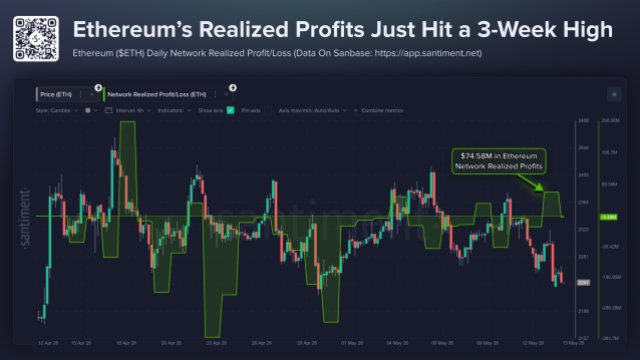
Recently, Ethereum has shown a promising uptick in realized profit margins. According to recent data from Santiment, a platform specializing in market intelligence and on-chain analytics, Ethereum experienced its highest recorded network realized profits in three weeks.
This trend may seem unexpected, especially since Ethereum’s price has seen a decline of approximately 5.5% over recent days. However, this can largely be attributed to the behavior of long-term holders who are choosing to sell during the dip, capitalizing on their advantageous cost basis.
During earlier months, despite heightened market uncertainty and geopolitical tensions, many traders strategically accumulated Ethereum when it hovered below the $2,000 mark. Now, those who bought during this accumulation phase are finding themselves in profitable positions, leading some to liquidate their holdings while market conditions still appear favorable.
Additionally, Santiment noted an uptick in on-chain activity within the Ethereum blockchain. The data indicates considerable price consolidation around $2,241, representing an increase in distribution activity. Historically, an uptick in transaction volumes correlates with an increase in realized profits and losses.
Current trends among Ethereum traders suggest a cautious approach. While there may be hesitance, this does not imply that new investors should adopt a bearish outlook. Analysts recommend monitoring for deeper realized losses, which might signal a market bottom, while suggesting a more conservative strategy until clear signs of the distribution phase’s conclusion are evident.