As Bitcoin continues to face intense pressure, its ability to reclaim previous highs seems hindered by an environment of uncertainty. The broader cryptocurrency market is experiencing fluctuations, reflecting a growing cautiousness among investors. Recent research indicates that the flow of new capital into Bitcoin has significantly dipped, suggesting that selling pressure is not being countered by fresh investments.
Evidence shows that over the past month, Bitcoin has faced a staggering outflow estimated at around -$2.5 billion. This scenario depicts a clear trend of capital exiting the market, diverging from typical patterns observed during bullish periods. Usually, when prices drop in a bull market, new investors step in to take advantage of lower prices. Currently, however, there appears to be a collective hesitance among potential buyers, leading to an overall defensive sentiment among market players.

Furthermore, the absence of significant inflows, which are usually the hallmarks of promising price rallies, highlights the existing challenges. Liquidity seems to be tightening as many existing holders are opting to rotate their investments rather than welcoming new market entrants. Without a revival in investor interest, Bitcoin may struggle to gain upward traction, with resistance levels likely to remain intact as the search for a market driver continues.
Bitcoin’s Current Landscape Reflects Bearish Tendencies
Insights from recent analyses suggest that Bitcoin’s trajectory is increasingly echoing typical bearish trends seen after major market peaks. During times of robust market activity, price corrections often pull in additional investments as individuals seize the chance to buy at lower prices. Conversely, in the current market, even minor price declines are triggering substantial pullbacks, indicating a shaky environment. Current blockchain metrics suggest that Bitcoin’s position may indeed be aligning with these earlier bearish trends.
Data collected indicates that potential buyers who usually step in during price increases are becoming increasingly inactive. This change means that market price fluctuations are now mostly due to the movement of existing capital rather than new investments. The lack of fresh capital injection generally corresponds to reduced market momentum and heightened volatility.
Unless there is a resurgence in incoming investments, any short-term price gains are likely to be temporary, failing to signal a meaningful market reversal. This condition resonates with the early stages of bearish market cycles that are often marked by dwindling liquidity and uncertain investor sentiment. Historically, markets tend to remain susceptible until there is a significant influx of new demand.
Consequently, Bitcoin’s potential for recovery remains largely confined, with future price changes heavily reliant on the arrival of new capital into the market.
Identifying Key Support Levels
The weekly analysis of Bitcoin reveals a visible decline in market integrity, particularly following its inability to maintain levels between $120K and $125K. The previous trending pattern has sharply shifted from making higher highs to lower highs, coupled with increasing volatility—hallmarks of mid-bear market phases. The recent movement towards the $65K-$70K region suggests that sellers maintain an upper hand.
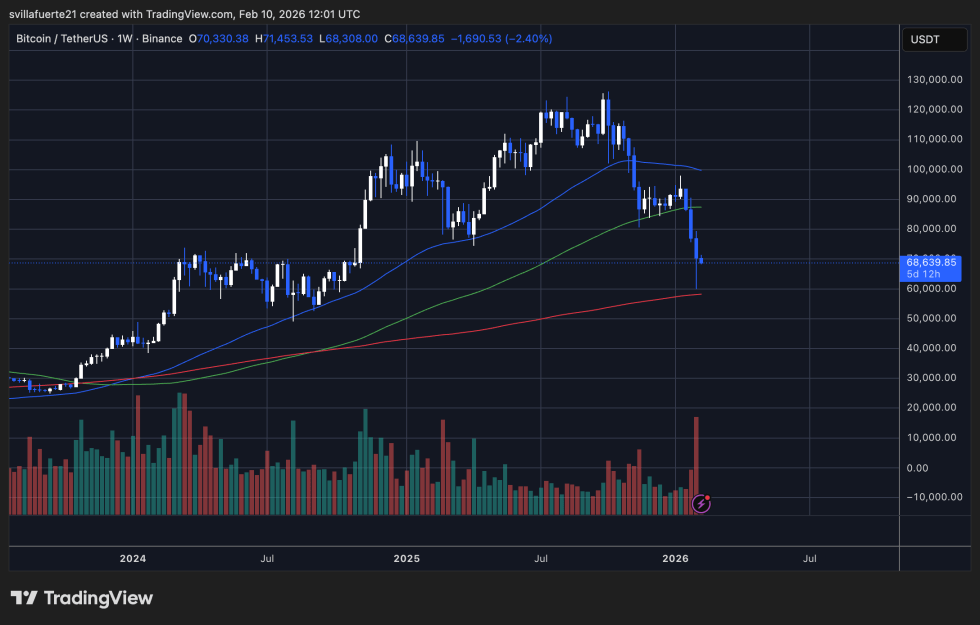
From a technical standpoint, Bitcoin has slipped below its short-to-medium-term moving averages, while the longer-term support line, hovering around the high-$50K area, stands as the last major level to hold. Historical patterns suggest that prolonged trades beneath the 50-week moving average typically signify extended periods of consolidation or significant corrections, rather than quick rebound attempts.
Moreover, it is essential to monitor trading volumes. The latest declines accompanied a surge in selling activity, hinting at forced selling rather than measured profit-taking moves. This scenario often leads to increased volatility as ownership shifts from weaker hands to stronger portfolios.
On a broader scale, the $62K-$65K range is becoming increasingly critical as a potential support zone. Maintaining stability within this area could improve market confidence and foster accumulation. However, a break below this level may expose Bitcoin to sharper declines, possibly targeting levels reminiscent of previous bear market phases.
Image source: Unsplash, chart from TradingView.com