As the landscape of memecoins evolves, projects like MemeToro are introducing innovative solutions to enhance security and trust among investors. The advent of memecoin launches has simplified the process for creators, making it easier to convert internet phenomena into tradeable digital assets. However, this accessibility has raised concerns about potential risks, particularly related to developers’ control over investor funds.
One of the primary issues is the prevalence of rug pulls, where developers may withdraw liquidity, abandon their project, or exploit hidden contractual powers against token holders. To combat this, MemeToro is developing an open-code approach through its AI-powered memecoin launchpad on the BNB Chain.
MemeToro’s Commitment to Transparency
MemeToro is addressing the challenges faced by many new memecoin projects by offering publicly inspectable code. This ensures that potential investors can access critical information regarding funding, liquidity, and developer control before committing their resources. The project’s GitHub repository contains crucial development materials, including an AI proposal pipeline and the FairLaunchEscrow framework.
The platform follows a systematic approach labeled Propose, Verify, Fund, and Launch. In this process, an AI agent develops potential memecoin concepts, while public contracts enforce the agreed-upon funding conditions. This divisibility of functions is designed to enhance clarity and trust among participants.
MemeToro’s AI agent not only generates concepts but also elucidates the rationale behind them. Smart contracts are structured to regulate contribution limits, deadlines, refunds, and finalization requirements. By making these elements public, external developers can verify the rules prior to the actual launch of the platform.
Developing a Secure Funding Structure
A significant focus for MemeToro is addressing concerns surrounding fund management post-contribution. The design of FairLaunchEscrow aims to ensure that fund movements adhere to predefined contractual conditions, mitigating risks associated with rug pulls.
The draft contract outlines parameters such as minimum funding thresholds, hard caps, wallet limits, and refund pathways. An update to the contract introduces defined withdrawal windows, preventing round finalization while the window remains open. Key features of the proposed processes include:
- Clear Terms: Essential information about supply, pricing, and funding conditions is made public before contributions.
- Withdrawal Rights: Contributors can exit within a specified timeframe.
- Refund Policies: In the event of unsuccessful funding rounds, provisions are in place for returning contributions.
- Liquidity Protocols: Successful rounds guide funds towards locked liquidity.
While the FairLaunchEscrow contract has not yet been deployed, the published code allows for preliminary technical assessment, with plans for separate security evaluations prior to full implementation.
MemeToro’s Enhanced User Experience
MemeToro is also creating a funding interface that connects users directly to smart contract functions. This integration simplifies processes for joining funding rounds, withdrawing funds, claiming tokens, and requesting refunds.
The benefit lies in the enhanced accessibility; if the MemeToro website were to go offline post-contract deployment, investors could still interact with the smart contracts through other compatible blockchain interfaces. Additionally, the introduction of proposal fingerprints will help link AI-generated proposals with their corresponding funding parameters, further aiding transparency.
Fundraising Success and Future Plans
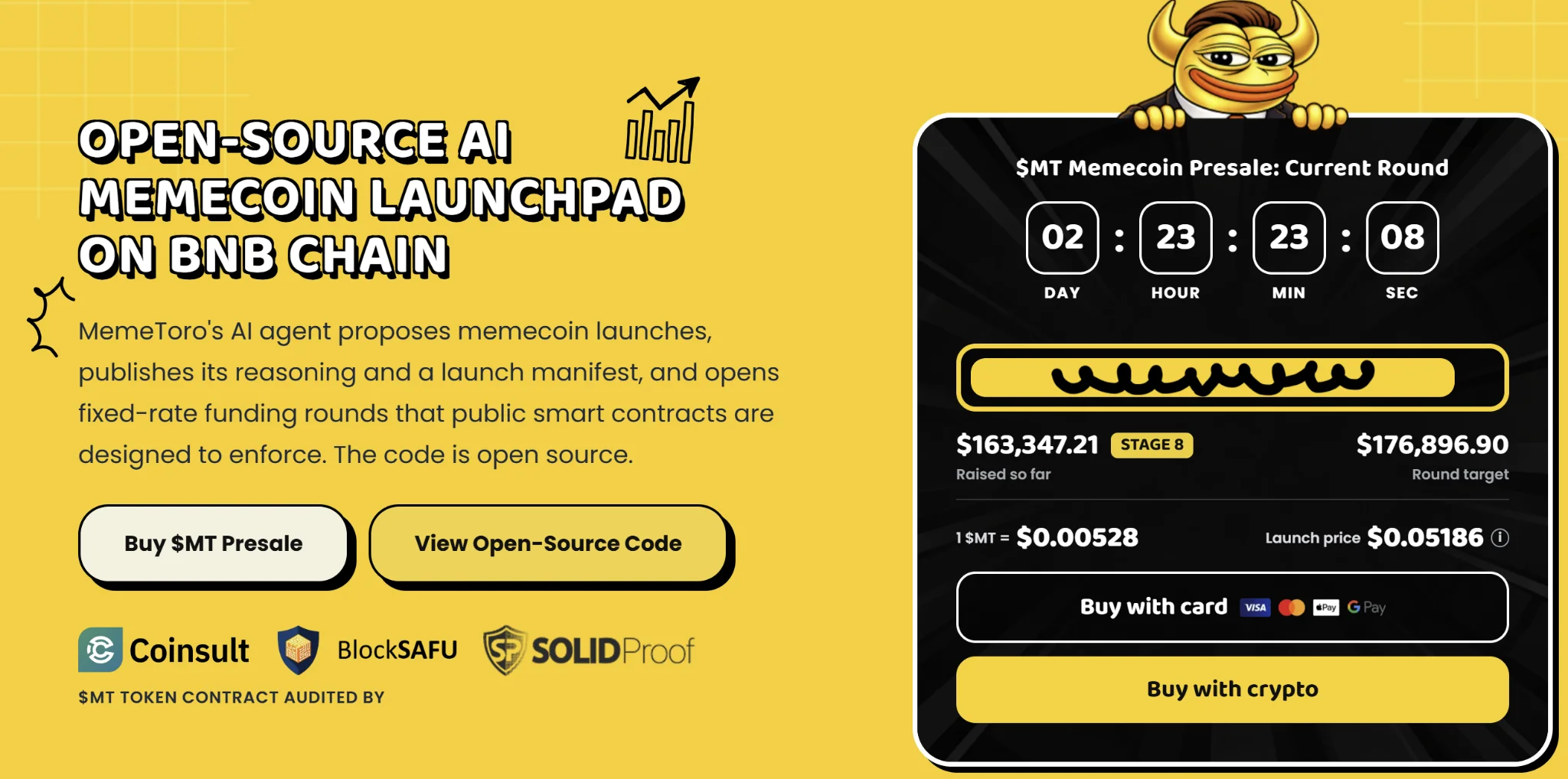
In its latest presale, Stage 8, MemeToro raised over $163,000, with the token valued at $0.00528. The project has a total supply capped at 1.2 billion tokens, with 852 million allocated to the public sale and the remainder earmarked for exchange reserves, marketing, trading, and team activities.
MemeToro plans to utilize its native token, $MT, for platform access, transactions, staking, rewards, and various memecoin-related services. At the current presale price, a $500 investment translates to approximately 94,697 $MT tokens before transaction fees. If the token value were to rise to $0.05186, this investment could hypothetically soar to nearly $4,911.
With aspirations for features that connect its AI discovery framework to broader market dynamics, participants can stay updated via MemeToro’s how to join page.
Conclusion: Elevating Standards in Memecoin Launches
MemeToro’s proactive approach to openly publishing code sets a new benchmark for memecoin launches, emphasizing the importance of transparent funding mechanisms. By introducing structures such as the FairLaunchEscrow, the platform aims to protect investors from potential malpractices while ensuring that essential funding rules are visible and understandable.
The upcoming milestones include further technical reviews, the ultimate deployment of the system, and demonstrating the efficiency of the funding processes in a live environment. Through these initiatives, MemeToro aspires to establish a robust ecosystem on the BNB Chain.
FAQs
Why has MemeToro made its smart-contract code public?
The public offering of development code allows users and developers to scrutinize funding guidelines, withdrawal rights, and proposed protective measures within contracts.
How does MemeToro address the issue of rug pulls in memecoins?
The platform introduces public launch terms, wallet limitations, refund protocols, and liquidity guidelines aimed at reducing unregulated developer oversight.
Has the FairLaunchEscrow contract undergone an audit?
Not yet. The FairLaunchEscrow is currently only a draft for development, with plans for independent security assessments before its production usage.